

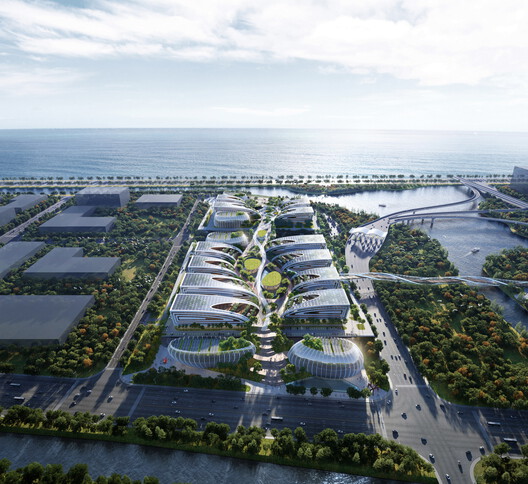
Infrastructure has long defined the backbone of cities by linking people, landscapes, and economies through systems that often go unnoticed until they fail. Today, as global challenges demand more adaptive and human-centered responses, architects are rethinking what infrastructure can be: not just a framework for movement and utility, but a catalyst for ecological restoration, cultural continuity, and civic imagination. The following unbuilt projects, submitted by the ArchDaily community, explore this expanded role of infrastructure, where airports, bridges, industrial parks, and pedestrian networks become architectural expressions of connection and care.


From Albania's Vlora International Airport by XPLAN Studio and Lithuania's Vilnius Airport Terminal by Aplan, where flight becomes a metaphor for national identity and global exchange, to China's Binhai Water Plant Industrial Park by POA Architects, which fuses traditional symbolism with sustainable innovation, these proposals reveal a new architectural language for utility and progress. In Jeddah, VOW Urban Pedestrian Hub envisions a multi-level bridge reinterpreting public space in the post-pandemic city, while Iran's Blue Health Station transforms river regeneration into a spatial act of healing. Meanwhile, the Glass Bridge prototype by Massive Form in Pennsylvania redefines material boundaries through experimental construction, and Nuovo Bernasconi in Italy reimagines mountain infrastructure as an off-grid refuge at the edge of endurance.


